MAGE — WIZARD
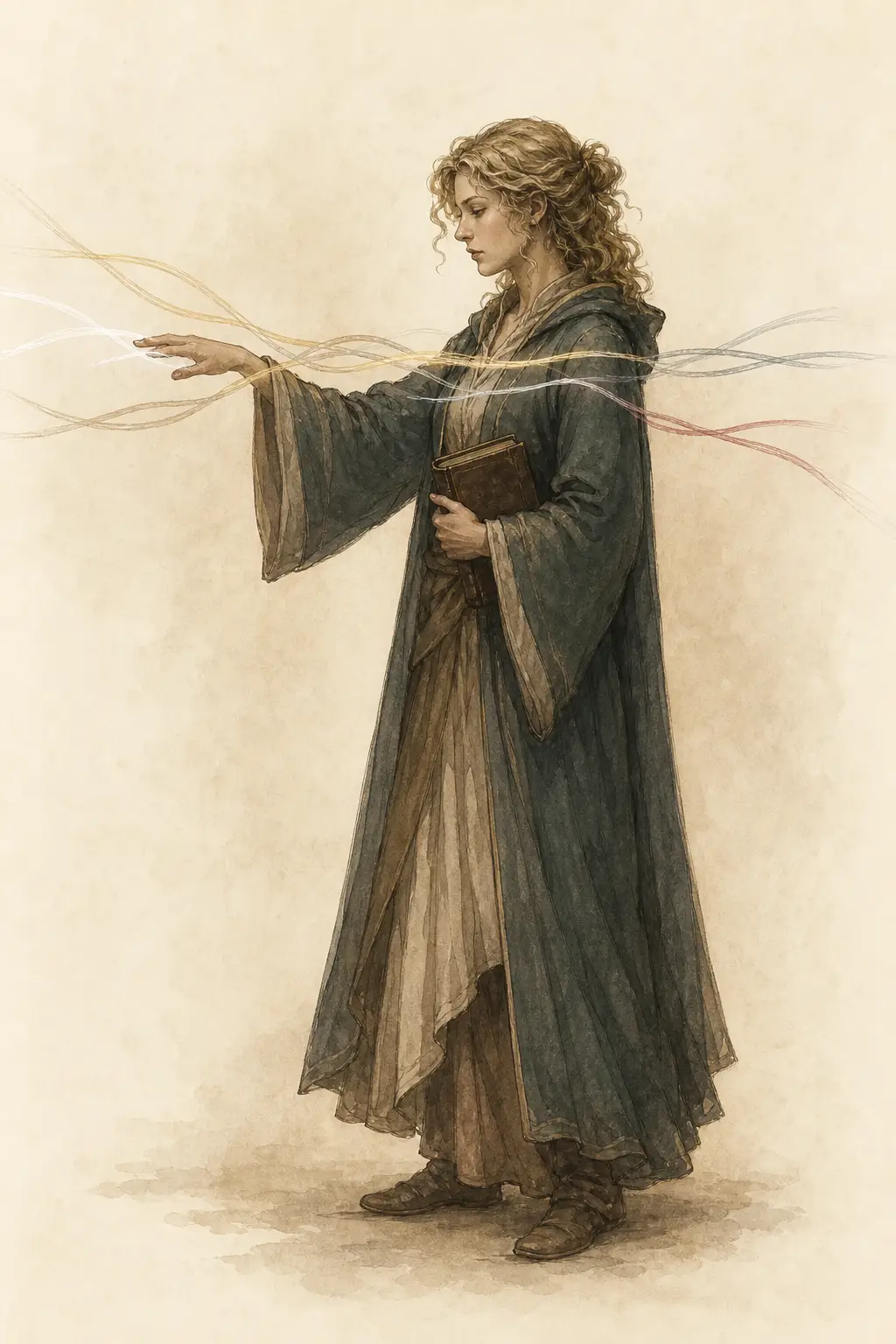
Salorras Path: Mage · 3.5e base class: Wizard The mage is Salorras’s scholar of the arcane — the studied spellcaster who learns to read and pull the Threads of the Fabric that underlie all magic. In 3.5e terms the mage is built on the Wizard class. The elite tradition a mage may rise into (the Entropist, master of the Pale Thread) is a prestige class entered once the character meets its requirements.
This file is a self-contained 3.5e reference. Mechanics follow the standard D&D 3.5e SRD Wizard; only the framing is Salorras-specific.
No schools of magic — the Fabric and its Threads. Salorras has no “schools” of magic. All magic is drawn from the Fabric and its five Threads. What the 3.5e rules call a school is, in Salorras, a facet of a Thread (see the table below). A wizard who specializes is mastering a Thread-facet and turning away from others; the mechanics are unchanged, only the framing.
Game Rule Information
Abilities. Intelligence determines the mage’s spell power, bonus spells, and save DCs. A high Dexterity and Constitution help a famously fragile class survive.
Alignment. Any.
Hit Die. d4.
Class Skills
The mage’s class skills (and the key ability for each) are Concentration (Con), Craft (Int), Decipher Script (Int), Knowledge (all skills, taken individually) (Int), Profession (Wis), and Spellcraft (Int).
Skill Points at 1st Level: (2 + Int modifier) × 4. Skill Points at Each Additional Level: 2 + Int modifier.
The Mage (Wizard)
| Level | Base Attack Bonus | Fort | Ref | Will | Special |
|---|---|---|---|---|---|
| 1st | +0 | +0 | +0 | +2 | Summon familiar, Scribe Scroll |
| 2nd | +1 | +0 | +0 | +3 | — |
| 3rd | +1 | +1 | +1 | +3 | — |
| 4th | +2 | +1 | +1 | +4 | — |
| 5th | +2 | +1 | +1 | +4 | Bonus feat |
| 6th | +3 | +2 | +2 | +5 | — |
| 7th | +3 | +2 | +2 | +5 | — |
| 8th | +4 | +2 | +2 | +6 | — |
| 9th | +4 | +3 | +3 | +6 | — |
| 10th | +5 | +3 | +3 | +7 | Bonus feat |
| 11th | +5 | +3 | +3 | +7 | — |
| 12th | +6/+1 | +4 | +4 | +8 | — |
| 13th | +6/+1 | +4 | +4 | +8 | — |
| 14th | +7/+2 | +4 | +4 | +9 | — |
| 15th | +7/+2 | +5 | +5 | +9 | Bonus feat |
| 16th | +8/+3 | +5 | +5 | +10 | — |
| 17th | +8/+3 | +5 | +5 | +10 | — |
| 18th | +9/+4 | +6 | +6 | +11 | — |
| 19th | +9/+4 | +6 | +6 | +11 | — |
| 20th | +10/+5 | +6 | +6 | +12 | Bonus feat |
Wizard Spells per Day
A specialist mage gains one additional spell of each spell level they can cast, which must come from their chosen Thread-facet (school). High-Intelligence bonus spells apply on top of this.
| Level | 0 | 1st | 2nd | 3rd | 4th | 5th | 6th | 7th | 8th | 9th |
|---|---|---|---|---|---|---|---|---|---|---|
| 1st | 3 | 1 | — | — | — | — | — | — | — | — |
| 2nd | 4 | 2 | — | — | — | — | — | — | — | — |
| 3rd | 4 | 2 | 1 | — | — | — | — | — | — | — |
| 4th | 4 | 3 | 2 | — | — | — | — | — | — | — |
| 5th | 4 | 3 | 2 | 1 | — | — | — | — | — | — |
| 6th | 4 | 3 | 3 | 2 | — | — | — | — | — | — |
| 7th | 4 | 4 | 3 | 2 | 1 | — | — | — | — | — |
| 8th | 4 | 4 | 3 | 3 | 2 | — | — | — | — | — |
| 9th | 4 | 4 | 4 | 3 | 2 | 1 | — | — | — | — |
| 10th | 4 | 4 | 4 | 3 | 3 | 2 | — | — | — | — |
| 11th | 4 | 4 | 4 | 4 | 3 | 2 | 1 | — | — | — |
| 12th | 4 | 4 | 4 | 4 | 3 | 3 | 2 | — | — | — |
| 13th | 4 | 4 | 4 | 4 | 4 | 3 | 2 | 1 | — | — |
| 14th | 4 | 4 | 4 | 4 | 4 | 3 | 3 | 2 | — | — |
| 15th | 4 | 4 | 4 | 4 | 4 | 4 | 3 | 2 | 1 | — |
| 16th | 4 | 4 | 4 | 4 | 4 | 4 | 3 | 3 | 2 | — |
| 17th | 4 | 4 | 4 | 4 | 4 | 4 | 4 | 3 | 2 | 1 |
| 18th | 4 | 4 | 4 | 4 | 4 | 4 | 4 | 3 | 3 | 2 |
| 19th | 4 | 4 | 4 | 4 | 4 | 4 | 4 | 4 | 3 | 3 |
| 20th | 4 | 4 | 4 | 4 | 4 | 4 | 4 | 4 | 4 | 4 |
Class Features
All of the following are class features of the mage.
Weapon and Armor Proficiency. The mage is proficient with the club, dagger, heavy crossbow, light crossbow, and quarterstaff, and with no armor or shields. Armor interferes with the gestures of arcane spellcasting and can cause spells with somatic components to fail.
Spells. A mage casts arcane spells drawn from the wizard spell list, governed by Intelligence. To learn, prepare, or cast a spell, the mage must have an Intelligence score of at least 10 + the spell’s level; save DCs are 10 + spell level + Intelligence modifier. A mage prepares spells in advance from their spellbook after rest and study, and can cast any prepared spell. A mage begins play knowing all 0-level wizard spells (except those of any opposition Thread-facet) plus three 1st-level spells of their choice, and two more spells of any level they can cast each time they gain a mage level.
Bonus Languages. A mage may substitute Draconic for one of the bonus languages available because of their race.
Familiar. A mage can call a familiar, exactly as the standard arcane familiar (granting its master benefits and an empathic bond).
Scribe Scroll. At 1st level, the mage gains Scribe Scroll as a bonus feat.
Bonus Feats. At 5th, 10th, 15th, and 20th level, the mage gains a bonus feat, chosen from metamagic feats, item creation feats, or Spell Mastery. The mage must meet all prerequisites, and these are in addition to the feats every character gains by level.
Thread Specialization (optional). A mage may specialize as a master of a single Thread-facet (a school, in rules terms), gaining the bonus specialist spell per level shown above and a +2 bonus on Spellcraft checks to learn its spells — but must give up two other facets (opposition schools), and can never learn or cast spells from them. The Pale Thread’s entropy facet (necromancy) is the discipline of the Entropist prestige class below; per canon it is wild and forbidden, controllable only by masters.
The Five Threads of the Fabric
Every magical effect is a facet of one Thread; a specialist mage masters one Thread-facet. Use this to reframe any 3.5e school to Salorras canon.
| Thread | Governs (Salorras canon) | Facet (3.5e school) |
|---|---|---|
| Iron | force, war, raw blasting, warding/protection | Evocation / Abjuration |
| Pale | dimensional transit, summoning, dream, entropy (the dead-and-unmade) | Conjuration / Necromancy |
| Crimson | blood, living nature, reshaping matter and flesh | Transmutation |
| Golden | knowledge, oath, foreknowledge/prophecy | Divination |
| Obsidian | mind, charm, illusion, the unseen, fate/fortune | Enchantment / Illusion |
The Pale Thread was derailed by the eolmes in prehistoric eras and has acted wildly ever since — so its strand of entropy magic (necromancy) is forbidden to all but masters. The Entropist below is the Pale-Thread tradition.
Paragon Prestige Classes (the mage’s elite tradition)
A mage who meets the requirements may enter:
- Entropist — master of the Pale Thread: the entropic and necromantic magic of the dead-and-unmade, wild and forbidden, controllable only by the few (compare the apostle Magewraith, who reaches the same power through divine Kaith’otl).
(A mage who masters the Golden Thread — divination — may also qualify for the Echoe prestige class, the foresight tradition listed under the legatee path, which admits both arcane spellcasters and essencers. Mages of the other Threads — Iron, Crimson, Obsidian — use the corresponding 3.5e school reframed per the table above, until dedicated Salorras traditions are authored.)