ORCS
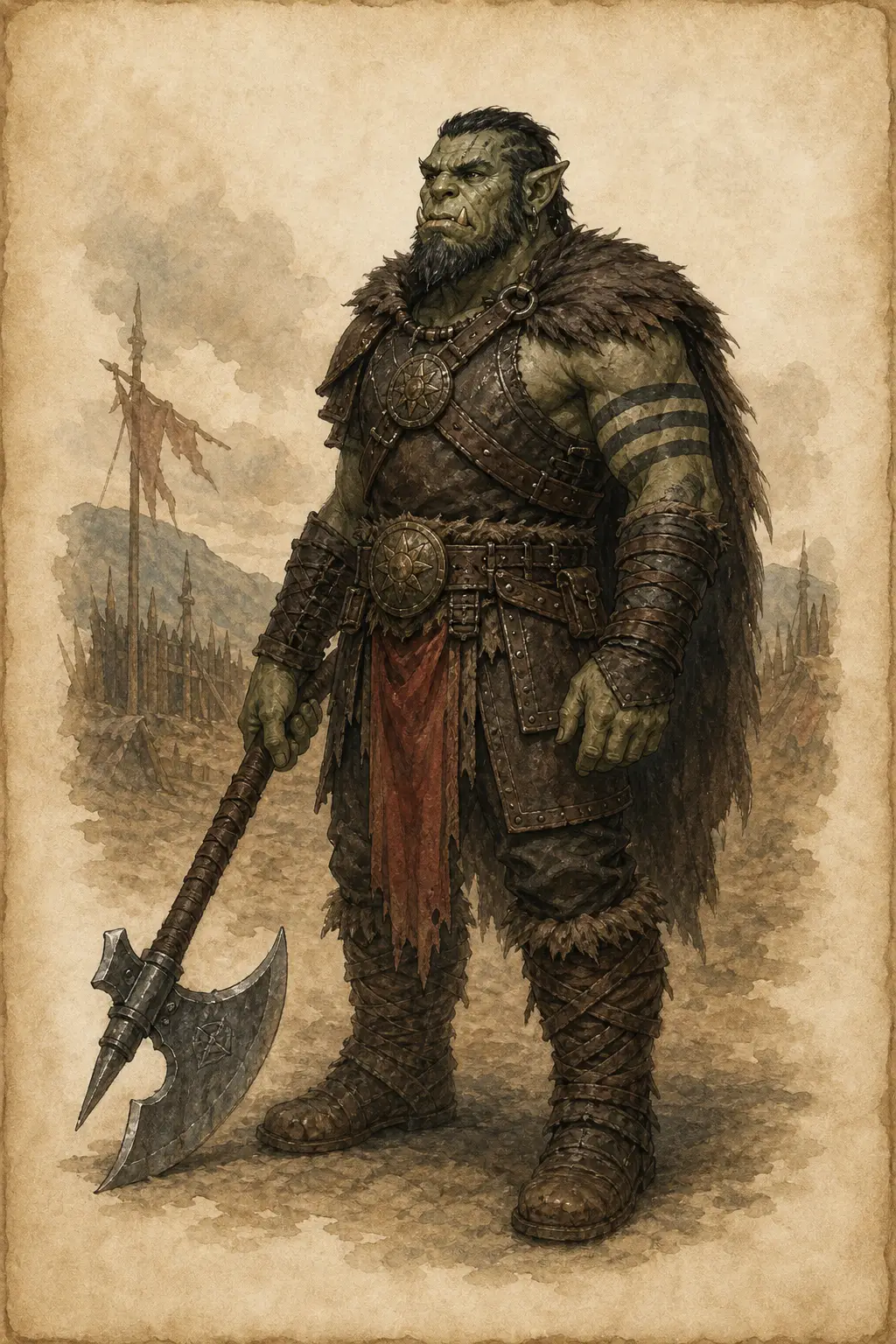
Salorras species: orcs — wild, matriarchal hunter-tribes of the Uzgar jungle who follow the primal faith of the Beast: fierce, independent, and bound to no kingdom but their own chieftains. Built on the Monster Manual orc as a player race, adapted for Salorras with a Level Adjustment. Orcs are a monstrous kindred in their own right — never human hybrids, the same category as ogres, trolls, and goblinoids.
Origin: Tribes of the northern Khalendianil plateaus and the Neluvia swamps, settled in Uzgar (western Asmeda) after the Demonic Wars Stature: Large and heavy for their Medium frame — grey to greenish hides, jutting tusks; among Asmedan orcs the females run the largest and strongest Lifespan: Short by the measure of the old peoples — adulthood comes fast, and few elders are seen outside the shamans Major Tribes: Red Fist · Swordneck · Bloodied Fang · Wrath of the Beast · Scratched Eye (twelve tribes in all) Faith: The Beast — a near-universal proto-pagan faith, kept by the tribal shamans Languages: Native — Orcish; common — Colloquial; regional — Naerysa, Phyrnal, Merylia
The orcs of Salorras are a wild and barbaric people, divided into many small tribes under the guidance of their chieftains. Their roots lie in the plateaus of northern Khalendianil and the hard-to-reach swamps of Neluvia; for ages they wandered the continent of Asmeda as nomads, until the close of the Demonic Wars gave them a land to call their own. Today most orcs of the world dwell in Uzgar — the untamed jungle territory of western Asmeda, known in its Braoran-conquest era as Thornwild, which Braora ceded to the orc tribes in 297 IIE so they might raise a culture of their own. For them, independence and self-reliance are first principles, and every child learns early to survive the hardships and dangers that lurk in the jungle interior.
Character
The orcs are independent, fierce, and disinterested in the affairs of the civilized world. To the other peoples they seem xenophobic and remote, and in truth they care little for what passes in the cities, having enough to settle in the standing feuds among their own tribes. They respect strength above all, and the right to hunt and live free of any crown. Most are content to be “lost” in the jungles and mountains, where they hunt unmolested for the wealth that nature offers. In the last century some orc bands have begun to live among the humans of the western towns, in an attempt at integration — a trend that has stirred an inner conflict among the tribes, for many chieftains are convinced it will sooner or later bring the degeneration of their ancestors’ ideals.
Appearance
The orcs are large and powerfully muscled, running heavy even for their Medium frame, with grey to greenish hides, coarse dark hair, and jutting tusks set in heavy jaws. Among the orcs of Asmeda a singular trait took hold from the time the statelet of Uzgar was formed: for some reason, after the Demonic Wars the females began to grow stronger than the males, and within three generations their weight, height, and muscle had visibly overtaken those of the males. Some whisper this is the work of the Citadel Researchers, one more experiment of the order’s geneticists; the orc shamans say instead that the Beast, having “found a mate” after the Demonic Wars, blessed the women of the orcs with unprecedented strength. Whatever the cause, the matriarchy of the Asmedan orcs was born of it.
Neighbors and Rivals
The orcs are reckoned xenophobic and remote by the other peoples, and they return the disregard. They keep practical, trade-bound dealings with the humans and Braoran colonists of Uzgar’s western towns, exchanging the rare creatures and minerals of the jungle for raw materials and steamtech arms. They share the jungle with pyrekin, eidolai, and elmaer minorities, and their hunters cross paths — often violently — with both the Dragon Hunters, a calling that has long united orcs of different tribes around the capture of dragons, and the rival Free Dragon Activists who shadow them. Most orcs, however, measure their world by the standing of their own tribe against the others.
Faith
Most orcs walk the proto-pagan path of The Beast. The faith is kept not by a priesthood but by the shamans who counsel each chieftain, and though the “laws” each chieftain sets differ from territory to territory, the worship of the Beast is one of the few threads common to every tribe. The shamans read the will of the Beast in the hunt, in strength, and in survival; among the Asmedan orcs they hold that the Beast’s favor is the source of the women’s might, and the religious authority of the shamans is, in this age, the surest road toward uniting the fractious tribes.
Conscience
Independent and wild, the orcs cannot stifle their desire to live free, nor be hemmed in by the laws of others. They divide into roughly twelve tribes, each with its own chieftain, its own territory, and its own shaman-advisors, and each tribe follows its chieftain’s voice faithfully. The chief cause of their endless skirmishing is the claim of hunting-grounds and mines, for on these the prosperity of each tribe depends — what the hunters and miners gather is the coin that buys goods and weapons from rich Braora. For all their division, all the tribes share certain lines: faith in the Beast, and the rite of sending their adolescents into isolation in the wild to harden them.
Orcish Domains
The orc tribes are the dominant power of the vast Dugarodt jungle of Uzgar. Their few urban dealings center on the capital, Baukrak, a city the Braorans built in 297 IIE shortly after the Demonic Wars to seat the close trade relations they developed with the orcs — but the orcs themselves live in encampments and small clearings within the jungle and the Morag mountains, visiting the towns only for trade. In recent years the chieftain Orlag of the Red Fist has risen among the loose order of chieftains, seeking to unite the tribes — by religious terms, her shamans counsel, since all the tribes believe to some degree in the Beast. Already the Bloodied Fang and the Wrath of the Beast have yielded to her shamans’ sacred summons, while the powerful Swordnecks under the chieftain Malegroth grow strong on their good relations with the humans and rich families of Baukrak. The seat of the Red Fist, deep in a rare clearing of the Dugarodt, is the encampment Ulag Gramot, where tradition demands the councils of the twelve chieftains take place.
Wanderers and Seekers
It is not common for an orc to leave the tribal lands for the wider world, though the harsh rite of adolescent isolation makes every orc a seasoned survivor by the time they come of age. Those who do wander are often hunters chasing wild and magical beasts, warriors in the service of a chieftain’s feud, or seekers drawn to the ruins and buried secrets the jungle hides — for the lands of Uzgar are strewn with the relics of a vanished granthir civilization, and an orc who finds such a “vein of gold” for the Braorans can buy their tribe great power.
Languages
The orcs speak Orcish, a harsh tribal tongue, and most who deal with the towns also learn Colloquial, the common tongue of Salorras, for the sake of trade. Depending on their dealings they may pick up the regional tongues of Asmeda and its neighbors — Naerysa, the Phyrnal of the pyrekin, or the Merylia of Neluvia — though most orcs care little for languages beyond what trade and the hunt require.
Orcish Starborns
No starborn of the orc tribes is recorded in the known history of Salorras. The orcs themselves set little store by such signs, measuring greatness instead by strength, the hunt, and the favor of the Beast — and an orc who rose above their kind would more likely be named a champion of a chieftain than marked as a child of the stars.
Names
An orc bears a given name, harsh and short in the mouth, and is known beyond their own by the name of their tribe. Tribe names are taken from the hunt and from war, and an orc earns standing — and sometimes a new by-name — through feats of strength, the hunt, and victory in the tribe’s feuds.
Given names: Orlag, Malegroth, Raigom, Grukk, Hraga, Vosk, Durnak, Mogra, Skarl, Ulga, Threg, Borgha, Naktul, Rhaga, Gormek, Ushka. Tribe names: Red Fist, Swordneck, Bloodied Fang, Wrath of the Beast, Scratched Eye.
Orc Racial Traits
The orcs are a monstrous kindred forged for the hunt and the hard life of the wild — broad, heavy, and strong beyond the measure of the common peoples, with the night-eyes of creatures born to the deep jungle and the deeper places of the world.
- Ability Scores: +4 Strength, –2 Intelligence, –2 Charisma. Orcs are tremendously strong but blunt and abrasive of manner, though their shaman-led survival instinct keeps their wits sharp.
- Medium: As Medium creatures, orcs have no special bonuses or penalties due to their size, though they run notably large and heavy for their frame.
- Speed: Orc base land speed is 30 feet.
- Darkvision: Orcs can see in the dark up to 60 feet. Darkvision is black and white only, but is otherwise like normal sight.
- Light Sensitivity: Orcs are dazzled in bright sunlight or within the radius of a daylight spell — a legacy of generations spent under the jungle canopy and in the deep places of the world.
- Orcish Blood: For all effects related to race, an orc is considered an orc. They can use magic items and abilities keyed to orcs, and are equally subject to effects that target the orc kind.
- Automatic Languages: Orcish and Colloquial. Bonus Languages: Naerysa, Phyrnal, Merylia, Dwarven, and the tongues of giants and goblinoids.
- Favored Class: Barbarian. A multiclass orc’s barbarian class does not count when determining the experience-point penalty for multiclassing.
- Level Adjustment: +1.