PYREKIN
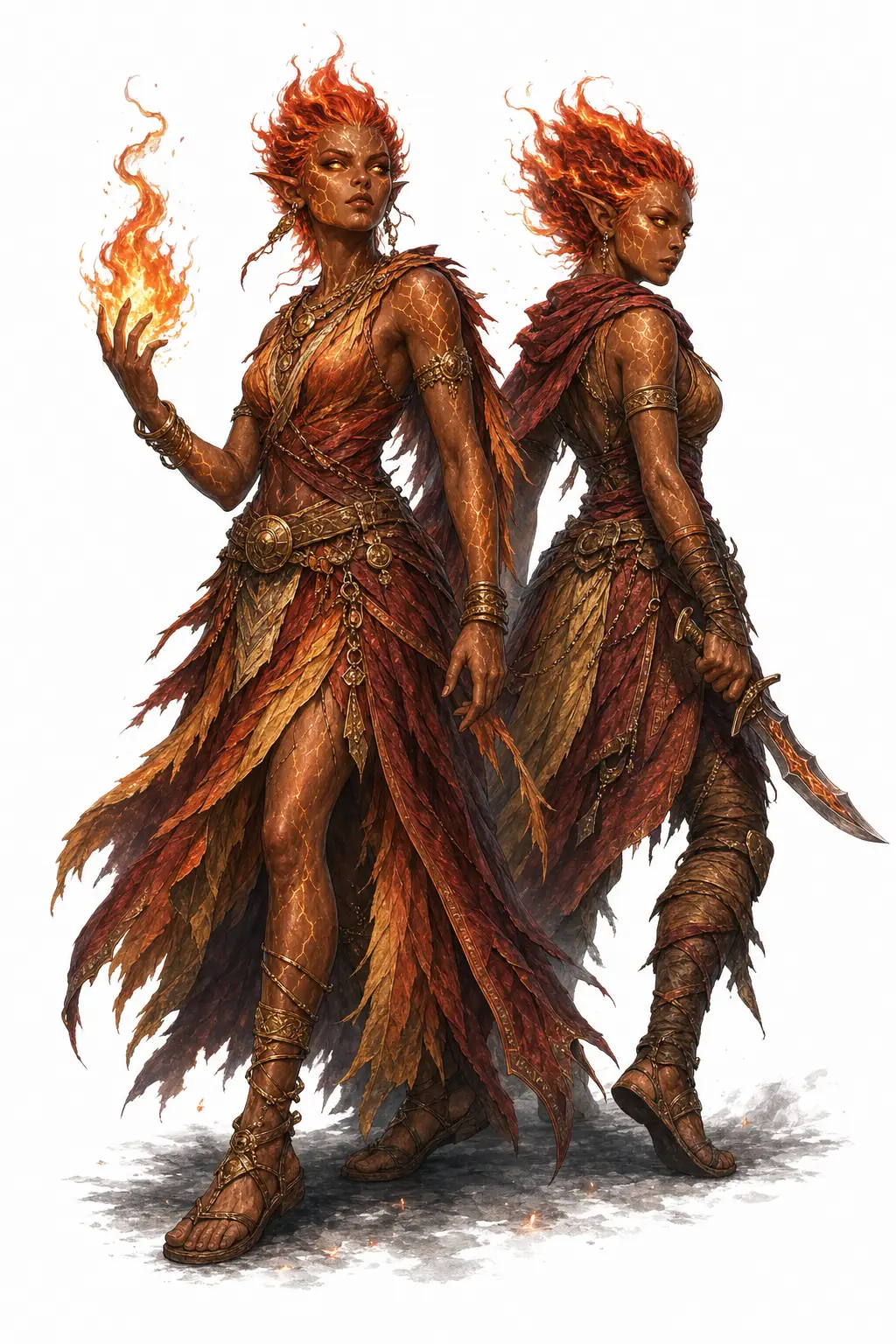
Salorras species: pyrekin — scions of the phoenix and the early isil elves, born always as identical twins who can fuse their two souls into a single extraplanar being: fireproof, magic-blooded, and untameable in their love of freedom. A custom Salorras race in a high Race-Point tier for its fire immunity and the twin-fusion gift. Pyrekin descend from elves and phoenixes — no intermediate form, no human blood.
Origin: Khalendianil — scions of the phoenix and the early isil elves, wedded to the protoplast beings of flame Stature: Taller than the average human, with fine features — red-skinned, hair of gold or cinnamon, black hooked talons, slit eyes Lifespan: A year in the chrysalis; adult at thirty; long-lived in the manner of elves Realm: Faeldar (Asmeda) — the first official statelet of the pyrekin; diasporas in Braora, the Free Cities of South, and Neluvia Faith: Orya — joined in Neluvia by the Queen Nara face, and contested in this age by the rising cult of the phoenix Arcalyx Languages: Native — Phyrnal (a fire-and-Elven dialect); honored — the wind-tongue of freedom; local — the dialect of the region of upbringing
The pyrekin are creatures who carry the blood of the imposing phoenix. Myth says their kind arose from the first elves of the isil family, when they drew near the protoplast and savage society of the terrible beings of fire. The pyrekin always come into the world in pairs, as twin siblings from the shared chrysalis they kept until hatching; the twins are identical and always alike as two drops of water. They are wise and charismatic beings, and by grace of their blood most are able to call upon magic. The pyrekin often spend their lives in a constant effort to flower their talents through experience; they love to travel to unknown and distant places, and they hold that freedom is the highest privilege life has granted them. Often their dealings with the other peoples come to an impasse, for they are famed for their volatile temper — “unsteady and unpredictable as the pyre,” as the people of the south say of them.
Each pair of twin pyrekin, at some point in life, comes into one of the most unearthly powers of their kind — that of the “fusion.” The two siblings can join their souls and bring into the material world the terrible existence of a pyrearchon. This alien creature is reckoned their guardian for the rest of their lives, and may take their “place” for some hours of the day. Though the phenomenon is not especially common, the rest of the world knows of it, and it stands as one more reason to shun this singular people.
Character
The pyrekin are known for their strong personality and their zeal. They are emblematic beings who profess rebirth, and it accompanies them through the whole journey of life. Though they chiefly seek harmonious coexistence with the peoples who share their land, there are cases where the wide racism shown them drives them onto the paths of vengeance and violence. The priceless right of freedom is a non-negotiable matter for most pyrekin — deprived of it they grow unbelievably violent and primitive, and there have been captive pyrekin who lost their reason and spent the rest of their lives as rabid beasts. The abrupt changes in a pyrekin’s mood are typical of the people, a volatility the other peoples explain by a myth that says the pyrekin reincarnate when they die.
Appearance
The height, weight, and muscular build of the pyrekin resemble those of elves. Their skin is golden-red on the breast and deep purple-red on the back. Their faces bear exotic and striking features — narrow noses, slit eyes of orange or green without brows, pointed ears, and prominent cheekbones. Their hair, gold or cinnamon, is usually long, though they delight in cutting it in singular ways. Their fingertips end in large, black, horny talons they can use as deadly weapons. Young pyrekin have small pseudo-wings that stretch like membranes from wrist to flank, letting them fly short distances; but on reaching adulthood the wings atrophy and are lost forever. The pyrekin hatch and are born from eggs called “chrysalises” over the span of a year, and come of age after their thirtieth year.
Neighbors and Rivals
Most peoples feel uneasy in the presence of the pyrekin, owing to their volatility and their unearthly nature; others esteem them deeply, sensing that this ancient people mirrors something primal, breathing out hope and strength. For their part the pyrekin feel most at ease among their own kind, and the displeasure of those who cannot identify with their beliefs does not trouble them — so long as it does not pass certain bounds. Into their societies are accepted those who hold liberalism and open-minded thought in their character; the square logic of the dwarves and the legislative bureaucracy of humans, for instance, can easily confuse them, for they reckon such minds “imprisoned” in rules of their own making.
Faith
The majority of devout pyrekin worship the doctrine of the goddess Orya. In her name they behold the primal power of the phoenix, a heavy inheritance they themselves carry. There are of course exceptions who may believe in any other deity; a respectable share of their people seated in Neluvia is known to serve the second face of the Mother — that of Queen Nara. In the Era of the Third Moon, with the rumored appearance of the first phoenix in the world after millennia, by the name of Arcalyx, many pyrekin began to glorify him as the new deity who brings the redemption of rebirth to Salorras — drawing the fierce reactions of their own kin faithful to Orya, who see the whole matter as sacrilege. Among the older pyrekin families faithful to Orya, religions such as that of the Weapon or the Beast are reckoned at once primal enemies, set against every value and ethos the Ash-of-the-Wind goddess professes.
Conscience
The inheritance of the phoenix and the deep roots of the elves set the pyrekin in a balance of moral chaos. Freedom is an ideological landmark in the way they live, and their deeds are often grounded in it. The pyrekin can cope within an ordered society, but they expend great effort to do so. They bond deeply with the members of their family, and especially the bond with their twin sibling is something that accompanies them for their whole lives — there is, after all, a saying in Salorras that likens two identical things to “two children of the pyre.” If there is one thing most pyrekin cannot accept, it is the deprivation of their choices and their freedom; against such a thing they react furiously and often violently, and there have been captive pyrekin who ended in madness.
Pyrekin Domains
Though the pyrekin people are among the most ancient, it is a paradox that they never held any tract of land or any established kingdom. Even in the Era of the First Moon they lived among the other peoples of the continent of Khalendianil, building small communities chiefly in the kingdoms of humans. To this day most prefer to live nomadically, often changing their roof, for they delight in migratory journeys and in the “turnings” of life.
During the catastrophic Demonic Wars in the Era of the Second Moon, the pyrekin of Asmeda fought and defended the lands of humans as no one else did. Hundreds were the fallen pyrekin warriors of that horrid period, who loosed the flame of their kind against the demons of Saragoth; and the least the state of Braora could do for this people was to grant them a tract of land — land that soon became the first official statelet of the pyrekin in history, Faeldar. This “unripe” state stands under the aegis of the Braorans, for the two have woven an alliance to the interests of both sides. Many pyrekin to this day live by the traditions of their forebears, so one commonly meets their kind in various places of the world, the overwhelming majority of them in the Free Cities of South, in Braora, and in the wild Dominion of Neluvia.
Wanderers and Seekers
From a young age the pyrekin learn from their traditions that what matters is not the destination but the journey. Through the journey of life, it is said, they learn the energies of the world and so prepare to reincarnate into the next life more ready. Most of them naturally develop their innate pyromantic gifts, for the blood of the phoenix sooner or later ignites within them and wakes the bond with their twin sibling — a power that needs no school or teacher to manifest. Money can persuade them to take part in some mission, but if the purpose is the smiting of an illiberal foe, then they offer themselves selflessly. Some pyrekin wish to honor the name of Orya or the phoenix Arcalyx; others stand against the tyrannical state of Praecaria; and there is no shortage of those who aspire, sword in hand, to a liberated world without borders or kings. In the Era of the Third Moon, with the arrival of the Dark Moon, the heroes of the pyrekin see the grim future of Salorras at the gates, as the world goes numb; within them, by grace of the phoenix’s blood, they foresense that the strange moon will strip the free will of all the world, silencing gods and mortals forever.
Language
The pyrekin speak Phyrnal — an altered dialect grounded in the tongue of fire with elements of the Elven tongue of the elves. They also know the tongue of the region where they grew. Often the pyrekin learn to speak the tongue of the wind, bound to the element of air — something they hold in particular reverence, for to them it represents freedom and an open spirit.
Pyrekin Starborns
In the history known so far, few were the pyrekin who showed the signs of the starborn. In the traditional tales of the people, it is said the starborn come as the Moons that bring the Eras come. Indeed, in the Era of the First Moon there came into the world the first twin starborn siblings, Kyraliis and Phorolxiis; centuries later they lost their lives in the terrible Battle of Smite during the Demonic Wars. In the Era of the Second Moon were born the twins Caelxiis and Saeloht. For years now a hatred rages between these twin starborn, since Saeloht followed the path of the phoenix Arcalyx — something his sister cannot accept, faithful as she is to the goddess Orya.
Names
The names of the pyrekin are bound to the elements of fire and air, and so most have roots in the tongues of fire and wind, though some have been markedly shaped by the tongue of the elves as well.
Male names: Aepher, Axhael, Conhex, Corphael, Fexutil, Fiinkoht, Hyres, Illixtil, Kehs, Kelcox, Nixalokht, Phalx, Piirtil, Sarphaxar, Sraelen, Taefoht, Thael. Female names: Afalxiis, Anaphira, Azka, Catenphiis, Ephexe, Feliikha, Friiphia, Ilnekha, Kaelress, Ktaelle, Nixiis, Phaliixha, Pyelle, Saess, Siinra, Telxiis.
Pyrekin Racial Traits (Pathfinder 1e)
In the veins of a pyrekin runs the blood of the phoenix — an inheritance so ancient and strange that it sets them apart at every level of their existence. They are descendants of the isil elves of the early years who mingled with the terrible protoplast beings of fire, and no child of theirs comes into the world alone; every pyrekin is born together with a twin, identical companion, sharing not only appearance but a deeper, more mystical binding that follows them their whole lives. Mechanically the pyrekin sits high in the Race-Point scale (roughly 17–18 RP — its total immunity to fire is one of the most expensive racial traits in the game, before the twin-fusion is even counted): a monstrous-tier race playable only with the GM’s express permission and a party able to bear its weight.
- Fire Subtype: Pyrekin are humanoids with the fire subtype.
- Ability Scores: –2 Constitution, +2 Charisma. Pyrekin are charismatic creatures, but somewhat fragile.
- Type: Humanoid (elf, fire).
- Size: Medium. Pyrekin have no bonuses or penalties due to their size.
- Speed: Pyrekin base speed is 30 feet.
- Phoenix Senses (Low-Light Vision): A pyrekin can see twice as far as a human in conditions of dim light. They also gain a +2 racial bonus on Perception checks.
- Elven Kinship (Elven Blood): For all effects related to race, a pyrekin is considered an elf. They can use magic items usable only by elves, and are equally subject to effects that target the elven kind.
- Hotblooded (Ex): A pyrekin’s blood runs surprisingly hot and resilient, granting a +2 racial bonus on saving throws against poison and disease.
- Phoenix Fervor (Ex): Fire magic is not something the pyrekin learn but something they remember. A pyrekin spellcaster determines bonus spells carrying the fire descriptor, and the saving throw DCs of such spells, as if their primary spellcasting ability were 2 points higher than its actual value (Charisma for sorcerers, Wisdom for divine casters, Intelligence for wizards). If the pyrekin has more than one spellcasting class, the bonus applies only to the first one acquired.
- Immunity to Fire (Ex): Pyrekin take no damage from fire, natural or magical.
- Healing Fire (Su): Any fire attack that would normally deal damage instead heals a pyrekin 1 point for every 5 points it would otherwise deal. A pyrekin cannot exceed its full normal hit points through this ability.
- Vulnerability to Cold (Ex): A pyrekin’s burning nature leaves them exposed to the opposite element — they take half again as much (+50%) damage from cold.
- Talons of the Phoenix: A pyrekin has a pair of natural claw attacks (primary natural weapons) that each deal 1d4 points of damage. A pyrekin who loses their weapon is never truly unarmed.
- Immolation Burst (Su): Once per day, as a full-round action, a pyrekin can immolate their body and release a burst of fire dealing 3d6 magical fire damage to everyone within a 10-foot radius (Reflex DC 10 + 1/2 the pyrekin’s Hit Dice + Charisma modifier, for half). Doing so also deals 3d6 damage to the pyrekin, as the energy is drawn directly from their own life essence. After bursting, the pyrekin enters a state of tranquil fire — treated as stunned and unable to act for 2 rounds, during which any creature that strikes or touches them in melee takes 1d10 fire damage. The pyrekin in tranquil fire may serve as the host for the twin-fusion (see below), or may choose not to merge.
- Pyrearchon Fusion (Su): As a full-round action, a pyrekin in tranquil fire can accept their twin sibling’s flames and merge, the two melding into one blazing mass to bring a pyrearchon — an outsider of the Continuum Ylaana — into the material world. While the mass is fusing it cannot defend itself and both siblings are considered helpless; the fusion completes after 1 round, and any creature that strikes or touches the fusing mass in melee takes 2d10 fire damage. The summoned pyrearchon’s statistics are those given in the pyrearchon entry, with Hit Dice equal to the host’s HD + 2 (maximum 24 HD). The pyrearchon acts once per round as a single dual-minded entity, its actions decided by both siblings — host and guest. The fusion lasts a number of rounds equal to the host’s and guest’s combined Charisma modifiers (minimum 1); the more harmonized the twins, the longer it endures. When it ends, the pyrearchon bursts in a release of fire dealing 1d6 fire damage per 2 Hit Dice to everyone within a 20-foot radius, then returns to its home Continuum, and the two siblings reform in place sharing one 5-foot square and the pyrearchon’s initiative. If the pyrearchon is slain, the release becomes the entity’s full Death Throes (see the pyrearchon entry), and the creature returns home leaving nothing behind but ash.
- Languages: A pyrekin begins play speaking Phyrnal and one regional tongue of choice. A pyrekin with a high Intelligence score may learn the wind-tongue, the ancient dragon-speech, Elven, Merylia, and other regional tongues.
- Favored Class: Sorcerer.