HUMANS
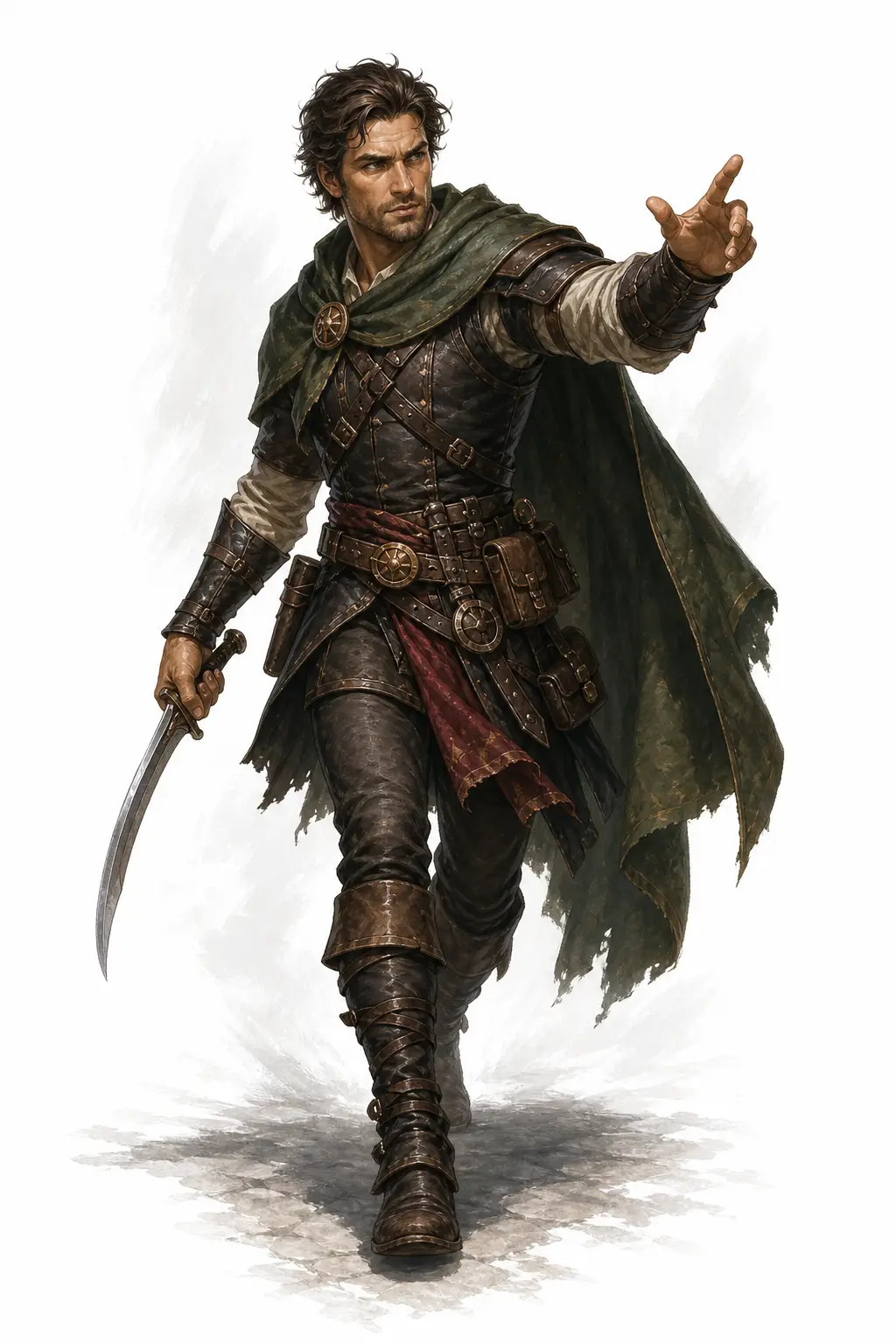
Salorras species: Humans — the adaptable, short-lived people who, over the last millennia, came to define the world of Salorras. A standard Pathfinder 1e human, whose three signature traits carry the Salorras touch of inborn Diverseness, Restless Talent, and a Path Without Bounds.
Origin: First societies of the Era of Myths in Asmeda — ancient cradles in Anseri and the Olythron valley of Khalendianil Stature: 1.50–2.05 m, 45–120 kg — endlessly varied across every region and climate Lifespan: Adult at eighteen; venerable around seventy-five Nations: Anseri · Braora · Free Cities of South · the kingdoms of Olythron · Praecaria · Katjemeran Faith: Ominous Three, Mother, Eone, Orya, Galiena, Kaith’otl, Thoraldor — and the rising cult of Nerkan Thak’Ar Languages: Native — Colloquial (Khalendianil); regional — Anserian, Naerysa, Katjemerani, Praecarian
Humans are a people who, over the last millennia, have come to define the world of Salorras. Their civilization suffered many falls and survived cataclysmic ages, until at last it consolidated and came to dominate nearly the whole world. As a people, humans stand out for their adaptability, their quick grasp of new things, and the sheer diversity of their traits and traditions — all of it a consequence of their relatively short lifespan, for which they “race” to keep pace with the elder peoples of Salorras.
Character
The human personality is surely the most varied among the common peoples. Their accommodating nature makes humans adaptable to any circumstance; their way of thinking can fall in step with another’s as easily as it can swing to the opposite extreme. A human may hold any habit, moral code, or political view in their temperament. As a consequence of their brief lives, humans tend not to think long-term about matters concerning the other peoples — they look to their own well-being, though this hardly means they live in disorder; on the contrary, they are creatures of organized societies who lay the ground for their descendants.
Appearance
The physical traits of humans, like their personalities, vary widely. Thanks to their adaptability and rapid reproduction, the human genetic code has shifted many times across the history of Salorras, so that distinct bodily differences arose among their peoples, shaped by the living and climatic conditions of each region. Skin ranges from pale white to deep black; hair from curly to wavy to straight, in shades of blond, brown, even raven-black, and hairstyles differ by region and the turn of fashion. Both men and women range between 1.50 and 2.05 m in height and from 45 to 120 kg in weight; humans reach adulthood at eighteen, and their average lifespan is about seventy-five years.
Dress changes greatly among their many nations and cultures. In Anseri, clothing has for centuries been airy, light-colored, even flashy, and Anserians favor gold accessories and jewelry. In Braora, fashion is a fast-moving pillar of the culture — warm, dark, but elegant clothing, distinctive hats, and discreet jewelry. In the Free Cities of South and in Praecaria, humans wear a simplified take on their traditional dress, sometimes with neoclassical notes. And in Khalendianil they prefer plain clothes in earthen, natural colors, fitted with accessories that quietly mark social rank.
Neighbors and Rivals
Humans have spread across every land of Salorras, and so have lived alongside all the other common peoples for centuries. From antiquity they had good chemistry with the elves of Khalendianil, and they coexist easily with the elmaers, the elves’ own engineered kin. With the dwarves their relations rest mostly on the exchange of inventions, though the two coexist and befriend one another easily. pyrekin and eyafen regard them with mixed feelings: they admire the free human spirit, yet at times judge humans greedy and vain. The eidolai and eyalen ria, for their part, reckon humans an immature people of fleeting power in Salorras.
Humans plainly define the Salorras of today. In the many faces of their character, many respect the world’s history and its elder peoples — often with love, even awe — while there is no shortage of the arrogant, who believe the age of other peoples is over and humanity’s hour has come.
Faith
Religion was always an important part of human life. Since ancient times they showed faith in their own deities without rejecting those of other peoples; and though humans today are not especially devout, there are always factions, great or small, who glorify the divine. The triad of the Ominous Three has always stood among the foremost human faiths, springing from their own history and offering a complete model of belief that often suits this many-sided people. Many revere the goddess Mother for her historic gifts to their kind, though some fear her or feel her an obstacle to their plans. Long ago, during their migration, the Anserians were aided by Eone and Orya, and ever since there are many places of worship to them across Asmeda.
Thoraldor and Kaith’otl are followed here and there, while the goddess Galiena has won many faithful in recent centuries as trade and industry grow year by year. Nor does this ancient people lack servants of The Weapon — the faithful in whose blood runs the primal residue of the ages of war. And in a people as changeable as humans, the rise of Nerkan Thak’Ar has bred a hundred questions: all know from history that the Cold-Hearted god was once a common mortal among them, and many see him as a champion of the human kind, swelling with awe and pride for their race; today there are thousands faithful to this “new” god and his pessimistic, murderous creed.
Conscience
The sharp variations in human character show in their morals too, which settle nowhere fixed. In broad strokes, though, the greater part of humanity lives in societies overseen by law and rules of ethical conduct; most are friendly to their fellows and helpful in need, but there is no shortage of those who look only to themselves, careless of the consequences of their deeds.
Human Domains
Humans always banded together and acted in groups to survive the harsh, primitive Salorras of old. That way of life led them to build great settlements that became cities over the years, and cities whole nations; and once gathered in numbers, they never stopped advancing, pressing on to conquer new lands. Studies confirm that the first prehistoric human societies of the Era of Myths lay in Asmeda. Millennia later, before the official calendar of Marness, humans had already established their civilization in nomadic groups in the Olythron valley of south-central Khalendianil and in Anseri of Asmeda — and it was only a matter of time before they spread and dominated the map.
Today they have settled across the whole world. By tradition they hold the Olythron valley to be home, for there they founded four independent kingdoms; on the continent of Asmeda humans outnumber all others by an overwhelming margin, especially after the migratory population boom of the mid–Era of the First Moon. Few places of the world remain untrodden by this unstoppable people — such as the virgin forests of Neluvia and the labyrinthine catacombs of Kahldur.
Wanderers and Seekers
It goes without saying that humans can’t live without action and adventure, and that they poke their noses where they shouldn’t. A passion for the unknown runs in their blood, and one may meet adventurers of this people anywhere in the world; driven by their adventurous nature, they never miss a chance to prove their worth to the elder peoples of Salorras. Of course, the reason a human takes up the wandering life always hides an unbridled hunger for glory and wealth — rarely does a human roam Salorras for personal pleasure alone; more often some further aim lies behind it, a monetary reward, an employer’s gain, or the pursuit of power.
Language
Humans, a people without fixed roots across the long and ancient history of Salorras, were forced to speak many tongues besides their own, and from this arose the many idioms and dialects that enriched their linguistic variety; today a different tongue is spoken in each region they hold, though the most common is the one that comes from the humans of Khalendianil.
The speech of the humans of Khalendianil, and of the Braorans of Asmeda, is the true tongue of their kind: Colloquial. It took shape in the ancient days of the elder continent, as humans, influenced by dwarves and elves, built its alphabet upon Dwarven and grounded its grammar firmly in Elven. For its ease and wide reach, Colloquial became the common speech of all Salorras — the shared tongue that bridges peoples and continents. In Anseri, humans always kept their own local tongue, Anserian, from which descended the dialects Naerysa and Katjemerani — tongues touched by Elven and spoken in southern Asmeda. The last known human dialect, not widely spread, is Praecarian, which wed Colloquial to the idioms of Anserian and Naerysa. It is not unlikely for a human to hold any of these as a mother tongue, depending purely on where they grew up, and it is common for them to speak more than one according to their social circles.
Human Starborns
The gift of the starborn seems something innate to the human race, for many have been recorded through history — speaking always in relation to the other peoples. Some became especially renowned and wrote their own history, while others wasted no time in joining the Starborn Brotherhood, building their fame to this day. Among the mightiest human starborn Salorras has known are Thryon Bral’Ar — lord of the Brotherhood; Atamal Warnn — the beastly tamer of horrors; Kyrthan Kane — tyrant of Praecaria; Ymenos Talak’Er — perhaps the most famed mage; Cornelia Bennett — the finest archer in the world; William Brewship — great seafarer of the four oceans; and Nerkan Thak’Ar — the dark blade of Salorras.
Names
The names humans use differ by the mother tongue they were baptized in, and so by the region they hail from. Humans of the Free Cities of South always carry a middle name as well, followed close by the family name through an apostrophe.
Male names (Khalendianil): Archie, Bartholomew, Cyrus, Gabrielus, Mordecai, Norbert, Otto, Queensy. Male names (Free Cities of South): Aragaem, Balarn, Daeran, Galimar, Matanys, Raeldam, Talon, Vimon. Male names (Anseri): Asukar, Baqidai, Faaskari, Hurbal, Jafaar, Malbeir, Soukai, Yombdam. Male names (Katjemeran): Eibupan, Darapan, Kileremvar, Nukelowak, Ponkalevar, Ropetakeo, Tarobakaski. Male names (Praecaria): Abados, Boravos, Dorian, Iolis, Karpos, Lorikian, Marallion, Xander. Female names (Khalendianil): Alianor, Bernice, Eva, Isolde, Johanna, Lucinda, Martha, Sonya, Theodora, Yvonne. Female names (Free Cities of South): Aresila, Danya, Elaera, Naelyda, Raneesah, Rimnyda, Saermys. Female names (Anseri): Alirah, Danhbia, Fatmar, Herbeyla, Ismyla, Markat, Salmiah, Wharamya. Female names (Katjemeran): Bokopovica, Daparilena, Jiarbar, Lubenazera, Milaparka, Pobalena, Rartika. Female names (Praecaria): Artemys, Aspyda, Cerelthea, Folorea, Iocastys, Kritamea, Lydirida, Renolpida.
Human Racial Traits (Pathfinder 1e)
Of all the peoples of Salorras, none is harder to capture in a single sentence than humans — the most varied, the most changeable, and the most unpredictable folk in the world, and that very diversity is their greatest strength. A human may never match the natural grace of an elf, the forged endurance of a dwarf, or the otherworldly insight of an eyafen, yet no other people can match the range of what an ordinary human is capable of becoming. The Salorras human is, mechanically, the standard Pathfinder human — and the three gifts the world has always ascribed to their kind map cleanly onto that chassis.
- Ability Scores — Diverseness: The human genetic code churns and reshuffles from one generation to the next far faster than in any other people, so that each human is born with a unique predisposition — one with uncanny strength, another with quick reflexes, another with a sharp mind, another with a magnetic grace. A human gains a +2 bonus to any one ability score at character creation, to reflect their varied nature. This is the Salorras human’s signature Diverseness.
- Type: Humanoid (human).
- Size: Medium. Humans have no bonuses or penalties due to their size.
- Speed: Human base speed is 30 feet.
- Restless Talent: Humans learn fast and dabble widely. A human gains a bonus feat at 1st level and 1 additional skill rank at 1st level and 1 additional skill rank at each level thereafter. (These are the Pathfinder human’s Bonus Feat and Skilled traits, recast as the Salorras human’s restless versatility.)
- Path Without Bounds: A human may begin life as a soldier, become a merchant in its middle, and die a mage without ever feeling they betrayed an earlier calling. Pathfinder imposes no experience penalty on multiclassing at all, so a human’s boundless versatility instead shows in their free choice of favored class — and in the favored class bonus they collect each level in it (an extra hit point, an extra skill rank, or an alternate racial favored-class option).
- Languages: A human begins play speaking Colloquial or one regional tongue of choice. A human with a high Intelligence score can choose any languages they want (except secret languages, such as Druidic). Humans mingle with all kinds of folk and can learn any tongue found in a region.
A Salorras human is built and balanced exactly as a core Pathfinder human (roughly 9–10 Race Points), and needs no special permission to play; the flavor above is naming, not added power.
Human Destiny
From the treatise “Humanity,” The Forbidden Archives, Naerys, 571 IE.
”…The human kind keeps showing its resilience across the Ages. It seems that our world has somehow ‘chosen’ humanity to carry out some higher aim — an aim so vague that we strive in vain to comprehend it…”
”…The dark past of our world, before the great cataclysm, shows us fragments of the first human civilizations. The stance of these forebears toward the prehistoric world is uncertain, for only a few digs have turned up signs of them…”
”…Hard to grasp remains the matter of the dozens of starborn who have passed through history. The power of humanity shows too in the anointing of the legatees, as the great entropist Ymenos Talak’Er notes in his essay ‘Heritage of the Seven’: ⟦őτε εκ θεύς Ãδωρις ώρέχθην αί χάρισμα παρ’ έγκλήρον είς τήν οίκουμένη, έκμαίευσε έν αύταί τήν υπόστασις παρά ροπής λαού αυτών⟧…” — in the old priestly tongue.
— Vhaelyra Nelk’Tar