ELMAERS — SPECIES
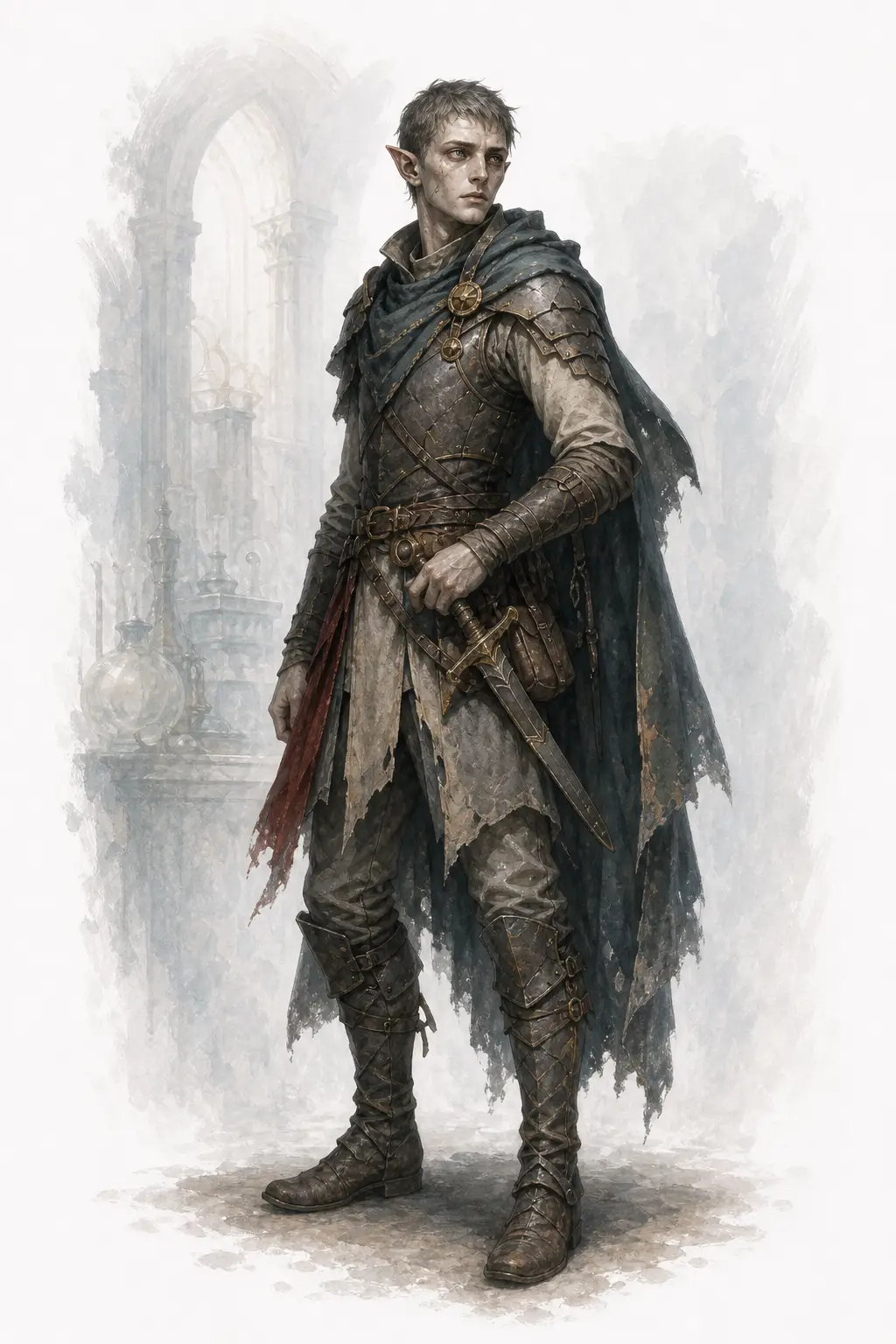
Salorras species: elmaers — the elves’ own lab-clones, pure elven stock shaped lesser than their makers: short-lived, with only a partial share of the elven gift, but uncannily versatile. 2024 has no “half-elf” species; this is a custom Salorras species capturing the elmaer’s elven senses, partial fey heritage, and engineered versatility. The elmaer carries no human blood.
Origin: Khalendianil — a making of the isil elves through entropic magic at the close of the Era of Myths Stature: 1.55–1.80 m, elegant and lightly muscled — faintly pointed ears, unable to grow fat Lifespan: Adult at twenty-two; venerable past two hundred Nations: Ylna’Anor (Asmeda) · Unverkettet (Neluvia) · large communities in Braora Faith: No fixed doctrine — many honor Eone, others worship freely Languages: Native — Colloquial or Elven, by region; local — Elmaerian (Unverkettet), Merylia (Neluvia)
The elmaers are a people of purely elven descent — clones shaped by the very hands of the elves, yet never in their full form. Their kind appeared at the close of the Era of Myths, when the isil elves wrought them through entropic magic, in their own image and likeness. Later, in the Era of the First Moon, history records the elmaers’ role as expendable soldiers against the orilyni — the alien invaders of Salorras of that age. For centuries their place in the world was met with cruelty, for they were never recognized as a “true” seed of Salorras. Though they carry some of the gift of true elves, the greatest difference from their “fathers” lies in longevity: elmaers live about one-fifth the lifespan of elves. Most people in Salorras have never seen a real elf, so the elmaers are called “elves” by many — not far from the truth, since elmaer translates from the elven tongue as “our offspring.” Today the elmaers have built their own culture, customs, and traditions, and live on lands they claimed and won with their blood.
Character
Heirs of the elven kind but raised closer to human societies, elmaers won the grace and calm of the one and the warmth and ambition of the other. They are known for their inventiveness, their minds working out solutions in an “artistic” way; airy and delicate creatures, yet never without the spark and impulsiveness when it is needed. Other peoples’ opinions of elmaer character diverge by region: where they have lived for many generations they took on the temperament of the wider population, chiefly humans, while in purely elmaer regions they adopted a way of thinking close to their elven “fathers.”
Appearance
Elmaers strongly resemble their forebears. Their facial features are nearly identical to those of elves, save for ears that are slightly smaller; their soft skin varies among light shades, their hair most often blond or soft brown, their eyes green or blue. They come of age after their 22nd year, and their lifespan does not exceed 200. Their build recalls the elegant elven silhouette, though somewhat more muscular; males usually stand 1.60–1.80 m, females 1.55–1.75 m. It is nearly impossible to see an overweight elmaer, for the metabolism and physiology they inherited from the elves prevents it. Elmaers tend to mind their appearance — said to be a way, born of the racism they suffered, to fit more easily into a “foreign” society.
Neighbors and Rivals
Elmaer relations with the world differ by region. On the elder continent of Khalendianil, elmaers are still reckoned bastards by the elves and pass indifferently before the eyes of the dwarves; the humans of the Old Kingdoms are more open to coexistence. In the New Kingdoms of the humans on Asmeda — especially in the state of Braora — elmaers have existed since the state’s founding and are an inseparable part of society; Braora has always had brotherly ties with the elmaer state of Ylna’Anor. On the wild continent of Neluvia, relations with the native eyafen and eyalen ria, and with the dwarven colonists, were baptized in fear when the sidelined elmaers built there the dictatorship of Unverkettet; trust there is scant and mutual, hardened by the elmaers’ own nationalist spirit. The pyrekin, wherever they hail from, hold most elmaers in sympathy — indeed, in the pyrekin state of Faeldar, coexistence with elmaers has run harmoniously for centuries.
Faith
Religion varies greatly among elmaers. As nomads and migrants who for years sought their place and ended up scattered across the world, they have served many deities. Elmaers who feel themselves true descendants of the elves more often believe in the Father of Elves, Eone; otherwise they may believe in any deity. Even in the purely elmaer region of Unverkettet, no teaching steers the young toward any particular god.
Conscience
As creatures, elmaers tend toward liberalism, justice, and mercy, owing to their elven blood. Even so, theirs is a people of many moral faces, depending on where and how they are raised — seen most clearly in the militarist regime of Unverkettet, where elmaers are raised by the principles the law commands, yet can grow ruthless toward those not of their kind.
Elmaer Domains
For many thousands of years the elmaers were a people without home or identity, all but outcast from whatever society they tried to join while they remained on Khalendianil, always seeking a new beginning. It came with the centuries, and now only a few of their communities remain in their birthplace. Many migrated to Asmeda with the second migratory wave of 506 IE; given the chance, they claimed a great tract of land and founded the first purely elmaer state, Ylna’Anor. Many live in large communities in Braora, and fewer in the Free Cities of South. Others fled to the exotic continent of Neluvia, where they built their own empire, that of Unverkettet — a land they defend in a daily battle against the goblinoids of the Beastlands.
Wanderers and Seekers
Elmaers are drawn with perfect ease to the adventurer’s life. Thanks to the harsh evolution of their kind, the art of survival is innate in them; they are keen students of life and their talents unfold very fast, which — together with their sharp senses — makes them remarkably adaptable in most circumstances. One may meet them even in the most remote latitudes of Salorras, never missing a chance to prove their worth where others would turn back; clients in need of a specialized mercenary adventurer stand a high chance of finding what they need in the daring spirit of an elmaer.
Language
Elmaers usually speak Colloquial or a local tongue, by the region they grew up in. Elmaers of Ylna’Anor prefer Elven, while those of Unverkettet have their own unique dialect, Elmaerian, and often also know Merylia — the Colloquial of the continent of Neluvia. They may, of course, know any other tongue, for their people is many-sided and gifted.
Elmaer Starborns
The only known elmaer recorded as a starborn in history is Aelnesia Arron’Thar — a great personage and eminent bard, whose life was taken by the Self-Slaying God Nerkan Thak’Ar in the year 945 IE.
Names
Elmaer names come most often from the cultures of either human or elven peoples; only the elmaers of Unverkettet use names truly their own.
Male names (elmaerian): Andol, Draknir, Dkardran, Greidnek, Krirdil, Moghas, Rermor, Sythmas. Male names (elven): Aerlathan, Caylor, Entrydil, Feyrith, Haemir, Kelvhan, Nuvian, Saevel, Taegen, Virion. Male names (human): Alfred, Amos, Brisco, Eugene, Lewis, Morris, Nicodemus, Aeganor, Daeryon, Aburan, Jazair, Ikarian, Rudollion. Female names (elmaerian): Chashega, Hesedna, Likhigna, Mezhedni, Nassari, Shakhandi, Zhigali. Female names (elven): Arryne, Ena, Fayla, Isilynor, Kaelitha, Lithonriel, Merethyl, Nuovis, Sylmare, Vealatha. Female names (human): Belle, Cornelia, Esther, Genevieve, Olivia, Penelope, Aelyra, Daenys, Vhaenyra, Casiopida, Theisys.
Elmaer Traits (5e 2024)
Elmaers carry some of the gifts of the people who made them — though never in their full form. They bear many of the traits of elves, yet some are atrophied, fallen short of true elves. Your ability scores come from your background, as in 2024.
- Creature Type: Humanoid. For any game effect that targets or affects elves, you also count as an elf (the world’s magic does not distinguish the elmaer from the elf).
- Size: Medium.
- Speed: 30 feet.
- Darkvision (Elven Lineage Senses): 60 feet.
- Partial Fey Ancestry (Elven Kinship): You have Advantage on saving throws to avoid or end the Charmed condition. (Unlike a true elf, the elmaer’s atrophied heritage grants no protection against magical sleep.)
- Keen but Lesser Senses: You gain proficiency in the Perception skill.
- Cultivated Aptitude: Each elmaer cultivates an innate knack taken from the blood rather than from teachers — you gain proficiency in one skill or tool of your choice.
- Versatile Mastery: The unfinished nature that long denied elmaers an identity now makes them learn whatever they take up faster than most. You gain one Origin feat of your choice — and whichever calling you follow, you make it your own with rare ease.