DWARVES
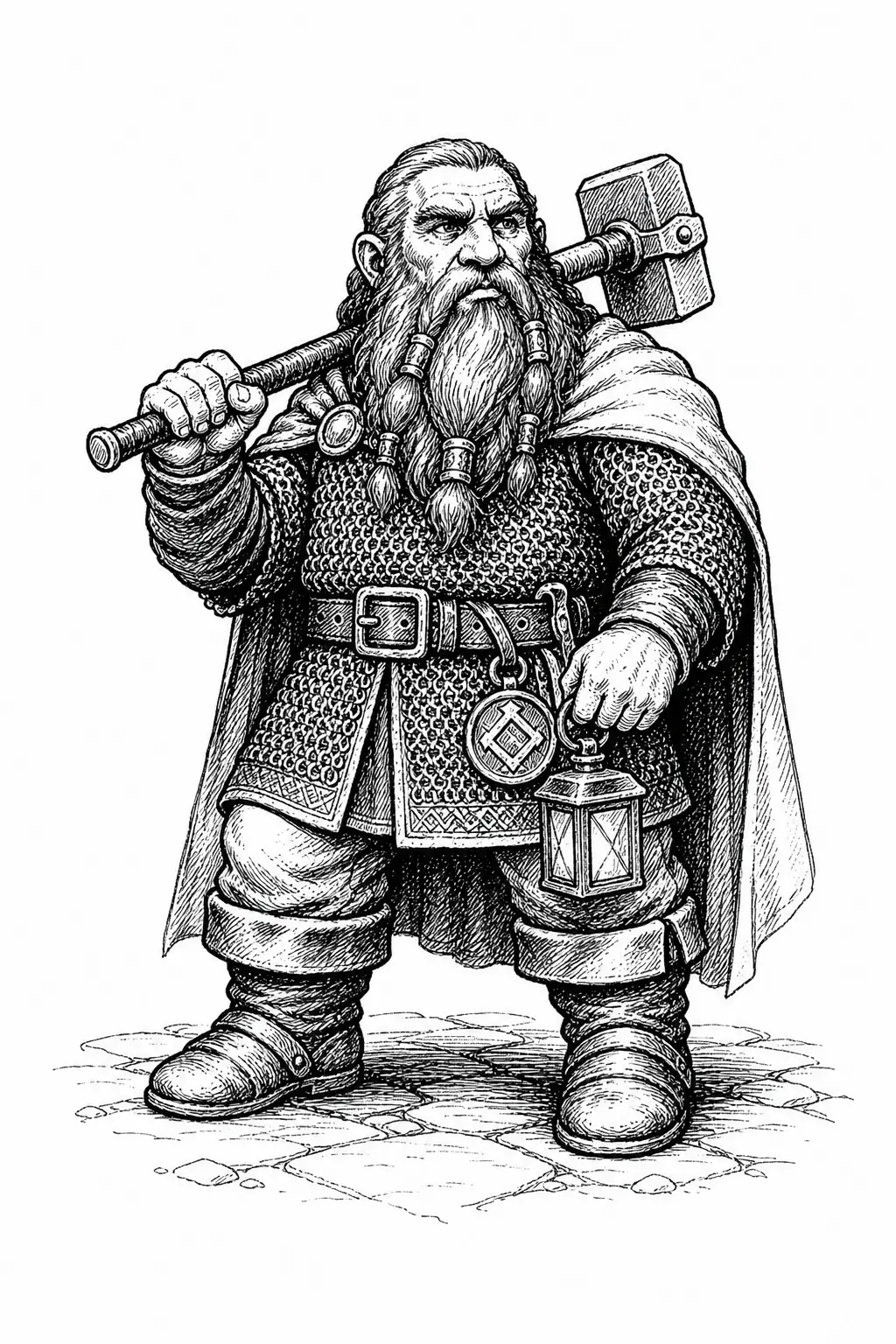
Salorras species: dwarves — born of stone and forge in the hands of Thoraldor: stubborn, honor-bound mountain folk and far-ranging traders, the masters of metal and the keepers of the law. A standard Advanced Fantasy dwarf, with Salorras clan lore and the canon language merge (Common → Colloquial). No referee’s permission needed — the dwarf is a core playable race.
Origin: Khalendianil — born of stone and forge in the hands of Thoraldor Stature: 1.20–1.50 m, broad-shouldered, dense with muscle, the beard worn as a badge of honor Lifespan: Adult at forty; venerable past three hundred Major Clans: Stonekings, Anvilforgers, Thunderguard, Craftmasters, Brutalstrikers, Blackbeards, Forgestriders, Darkseekers Faith: Thoraldor — near-universal across all clans; apostasy is reckoned a severing from the blood itself Languages: Native — Dwarven; common — Colloquial; regional — Braorian, Anserian, Naerysa, Merylia
The dwarves of Salorras are one of the oldest and most enduring peoples of the world. With roots cut deep into the continent of Khalendianil, the dwarves are not merely a folk of the mountains and the stone — they are explorers, traders, and bearers of knowledge. Though their hearts always belong to their kingdoms, the dwarves travel the world often, seeking experiences, rare goods, and wisdom. For a dwarf, every journey is an investment — not only in wealth, but in understanding of the world.
Character
The dwarves are stubborn, hard-headed, and often immovable in their opinions — yet that hardness is balanced by a deep sense of honor and fellowship. They are a well-loved people, with a strong presence and a character that rarely passes unnoticed. Their love for their own kind is absolute: a dwarf will always set the good of clan and kingdom above personal interest. At the same time they have a particular weakness for material goods — not merely as wealth, but as symbols of worth, craft, and history. They enjoy the company of other peoples, especially when it comes with trade, exchange, and stories, and they function strictly within the bounds of law and order, showing deep respect for the priests of Thoraldor and for their lords.
Appearance
The dwarves of Salorras are short but exceptionally sturdy humanoids, with bodies built to endure the hardships of mountains, wars, and endless journeys. Their height usually ranges between 1.20 and 1.50 meters, yet their broad frame and dense muscle make them look far more imposing than their stature suggests. Their facial features are strong and rough, with deep lines, heavy brows, and powerful jaws, while beards are a sacred symbol of honor and identity for most of the people — in certain clans regardless of sex. Their hair is usually thick and dark, though shades of red, grey, or blond appear after many generations under different climes; their eyes often carry metallic or earthen hues — deep brown, iron-grey, copper, or dark green. Dwarves come of age around forty, and their lifespan often passes three hundred years, with many elders still active in craft, trade, or counsel into deep old age. Their dress is practical but striking to other peoples — heavy, durable cloth, furs, leathers, often adorned with metal elements, chains, clan symbols, or elaborate embroidery depicting deeds and family origins.
Neighbors and Rivals
The dwarves hold a particular respect for the elves, reckoning them an equally ancient and foundational people of Salorras, though they always keep a wary stance, knowing the nature of the elves is hard to predict. With the autochthonous peoples of Neluvia they struggle to connect or fully understand. With humans, pyrekin, and elmaers they keep formal, practical relations, often grounded in trade and the exchange of know-how. In general the dwarves are reckoned approachable but demanding — friendly, so long as their rules are kept.
Faith
Faith is a foundational part of dwarven existence in Salorras, and nearly every facet of their society revolves around Thoraldor, the ancient god of creation, law, and endurance. For the dwarves, Thoraldor is not merely a deity to worship but the very father of their kind — the divine smith who shaped the first dwarves from stone and fire and taught them the worth of honor, work, and order. The temples of Thoraldor stand in nearly every dwarven kingdom, often carved deep within the mountains, with vast halls of stone and metal lit by eternal flames and molten forges. His priests hold high station, reckoned not only spiritual guides but guardians of law and tradition; dwarven kings rarely rule without their counsel. Though a few dwarves follow other deities, this is exceedingly rare and often met with suspicion, for to abandon Thoraldor’s teaching is reckoned almost like cutting oneself off from one’s roots and ancestors.
Conscience
The ethos of the dwarves has been shaped through centuries of wars, losses, migrations, and hard survival. They believe deeply in the worth of order, honor, and collectivity, always striving to keep a balance between law and practicality. Most dwarves act by strict codes of conduct and hold that strength without discipline leads only to ruin. Yet for all their severity, the dwarves are not cold or cut off from the world — they have learned through their history that no people survives alone, which makes them generally approachable and willing to forge ties when there is mutual respect. Their long history of conflict makes them unpredictable in moments of crisis: usually they prefer reason and diplomacy, but when their clans, families, or kingdoms are threatened they become implacable. For a dwarf, betrayal is among the greatest of sins, while the defense of honor and homeland is a sacred duty that outweighs even life itself.
Dwarven Domains
The dwarves first appeared on the ancient continent of Khalendianil, where to this day stand their holiest kingdoms and the deepest roots of their kind. The dwarven kingdoms are not united under a single empire but scattered across the whole continent, from the frozen ranges of the north to the stony valleys of the south; for the dwarves, every kingdom is sacred ground, soaked in the sweat, blood, and history of their ancestors. The first two clans of history were the Stonekings and the Anvilforgers, who made the famed “Descent of the Enlightened” shortly before the Era of the First Moon, when the first dwarves came out into the world of Salorras to seek knowledge, wealth, and new destinies. Centuries later came a second great age of exploration, known in dwarven tradition as the “Iron Searches,” which gave rise to the rest of the great clans — the Thunderguard, Hammerbattle, Craftmasters, and Brutalstrikers.
The youngest of the great clans are the Blackbeards, formed after the Demonic Wars from an offshoot of the Stonekings, when many dwarves were drawn by the lure of power and embraced the dark teachings of the demonic lord Jiazgalok; since then the Blackbeards are met with fear and suspicion, though they themselves hold they merely followed a different road of power and survival. Beyond Khalendianil stand two great clans abroad. The Forgestriders were once the clan of the Hammerbattle: when Durig “Steelbones” Hammerbattle and four hundred followers were blinded by the hatred of the Weapon and blackened the name of their kind, their own clan-king Grethim “Ironthrone” Hammerbattle condemned them to exile. The exiles sailed south to the isle of Solevna in the waters of Asmeda, renounced the stained Hammerbattle name, took the name Forgestriders, and founded the crowned theocracy of Gorndarat, dedicated to the Weapon. The Darkseekers, by contrast, are a unique clan of Neluvia, formed from dwarves of every origin who left their homelands seeking new opportunity and forgotten knowledge in the unknown lands of the isle — reckoned by many traditional dwarves as too cut off from the old values, yet undeniably among the boldest explorers of the world.
Wanderers and Seekers
The dwarves love adventure and travel deeply, especially in their youth, when they feel the need to know the world beyond the stone kingdoms of Khalendianil. For a young dwarf, the wanderer’s life is a way of gaining knowledge, wealth, and renown, and a chance to honor clan and name through deeds. Many travel seeking rare objects, lost crafts, or trade agreements, and not a few return to their kingdoms as heroes, seasoned warriors, or great merchants.
Languages
The dwarves have their own ancient tongue, Dwarven — a heavy, rough speech that sounds like stone grinding on steel, full of compound words, honorifics, and terms bound to metalwork, the martial art, and the history of the clans. Most dwarves grow up also learning Colloquial, the common tongue of Salorras, chiefly through trade and frequent dealings with other peoples. It is no accident that Colloquial comes so easily to them: its very alphabet was built upon dwarven script. The Forgestriders, isolated on Solevna, usually learn Braorian — the common tongue of Asmeda — owing to their place on the continent, while the Darkseekers of Neluvia usually know Merylia. In general the dwarves love languages when they serve trade, diplomacy, or the search for knowledge, and it is not rare to meet learned dwarves who know the tongues of lost civilizations.
Dwarven Starborns
Starborn dwarves are exceedingly rare in the history of Salorras, which makes their appearance treated almost as a divine sign by the clans. Most dwarves believe a starborn carries within a piece of the will of Thoraldor himself, and that their fate is bound to great changes for the kind. The best-known starborn of ancient times was Doriath “TrueWarrior” Stonekings, a legendary warrior of the first years after the Descent of the Enlightened; his deeds in the wars against the orilyni and his utter devotion to the dwarven kingdoms made him a symbol of the ideal dwarven soul. Doriath’s martial philosophy and combat techniques later became the foundation of the famed true warriors, a specialized warrior tradition of the dwarves that follows his principles to this day: absolute discipline, endurance, honor, and unbreakable will in battle. In the modern age, the best-known starborn is Durgan “GemFinder” Craftmasters, a wandering explorer and trader of rare treasures, famed for his gift of discovering forgotten mines, ancient objects, and precious stones where no one else could.
Names
The dwarves of Salorras bear the name of their clan as a family surname with immense pride, for to them lineage and the heritage of blood are sacred parts of identity. From birth, each dwarf receives not only their given name but an honorific nickname — a descriptor that parents or clan elders bestow in the hope of expressing the newborn’s drive, virtues, or destiny — reckoned as important as the true name and carried for life. As a dwarf grows, they may change their nickname through personal feats, martial victories, trade successes, or deeds that leave their mark on clan history; new titles are reckoned the highest honor and often pass into the legends of the kingdoms. Dwarven names are usually heavy and rough in the mouth, rooted deep in the Dwarven tongue and the ancient traditions of the clans.
Male names: Baern, Borin, Durgan, Kazrik, Morgran, Thorin, Orsik, Thrain, Bardok, Ragnar, Forodiumli, Bridok. Female names: Helja, Sannl, Vistra, Eldeth, Brynja, Gurdis, Hlin, Kara, Mardred, Torbera. Clan names: Stonekings, Anvilforgers, Thunderguard, Craftmasters, Brutalstrikers, Blackbeards, Forgestriders, Darkseekers.
Dwarven Racial Traits
The dwarves are a people forged of stone and fire in the most literal sense — the legends of their kind say Thoraldor himself shaped them on his anvil from rock and molten metal, and that origin shows in every facet of their existence. Short but unliftable, with bodies denser and heavier than their stature suggests, they were formed by countless generations beneath mountains, in mines, and around anvils.
Requirements: Minimum CON 9 Ability adjustments: +2 CON, −2 CHA — hardy and tough, but gruff and reserved (no score below 3 or above 18) Class access: Any Path or Paragon. The armsman is the dwarf’s ancestral calling — the dwarven warrior tradition of the true warriors, descended from Doriath — while the Thunderguard rune-sages walk the mage’s road.
- Infravision to a range of 60 feet, so that a dwarf works just as well in the dark of a mine as in daylight.
- Stoneborn Frame: A dwarf is almost impossible to shift from where they stand without their own consent. They gain a +4 bonus to resist being knocked down, pushed back, or tripped while on the ground, a +2 bonus on saving throws against poison, and a +2 bonus on saving throws against spells and magical effects — the same forge-hardened constitution that lets them endure cold, labor, and strong drink that would fell other mortals. A dwarf is never slowed by armour or a heavy load, keeping their full movement rate where others would be encumbered.
- Stone-Reading: Where another sees only a wall of stone, a dwarf reads its age, its making, and its weaknesses. When searching within 10 feet, a dwarf has a 2-in-6 chance to notice unusual stonework — sliding walls, sloping passages, new construction, stonework traps, an unsafe ceiling — and can intuit their approximate depth underground.
- Forge-Born Hands: In a dwarf’s hands, metal wakes. The referee grants them a decided edge (+2 or a 2-in-6 chance) at appraising the worth of goods and at crafting or repairing items of stone and metal — the inheritance of a divine craft, passed down like a mother tongue.
- Mountain-Bred Combat: Dwarves are at home with the dwarven waraxe and urgrosh. They gain a +1 bonus on attack rolls against orcs and goblinoids, the ancestral enemies of their kingdoms, and their small, braced fighting-stance grants a +2 bonus to Armour Class against creatures of giant size.
- The Code in the Blood: The dwarven sense of law and honor is no outward imposition but an inner anvil on which every deed is forged. A dwarf who has given their word keeps it; a dwarf who has accepted hospitality never turns a weapon on their host; a dwarf who has sworn vengeance never forgets. (Flavor, not a mechanic — but the heart of how a dwarf is played.)
Languages: A dwarf speaks Dwarven and Colloquial, and may learn Braorian, Anserian, Naerysa, Merylia, the earth-tongue, and the tongues of giants, goblinoids, and orcs.
Dwarven Clans
The dwarves are one people of one blood, but divided into great clans, each with its own craft, creed, and character. A dwarf bears the clan name as a surname, and a player should choose one — it shapes a character’s upbringing far more than any die roll.
| Clan | Hallmark | Domain |
|---|---|---|
| Stonekings | Keepers of history and the faith of Thoraldor | Khalendianil |
| Anvilforgers | Unbreakable warriors, the wall of the front line | Khalendianil |
| Thunderguard | Sages of the runes, the mages of the kind | Khalendianil |
| Craftmasters | The foremost artisans and smiths of the world | Khalendianil |
| Brutalstrikers | Heavy arms and an aggression that breaks shields | Khalendianil |
| Blackbeards | Adaptable survivors of the Demonic Wars | Khalendianil |
| Forgestriders | Exiled former Hammerbattle, theocrat servants of the Weapon | Solevna |
| Darkseekers | Explorers of lost places and forgotten knowledge | Neluvia |
The Stonekings are the keepers of dwarven history and the faith of Thoraldor; raised among chroniclers and priests, they gain an encyclopedic knowledge of the ancient tales and sacred teachings, and that same faith shields them where others bend to terror or dark influence. The Anvilforgers are the most enduring warriors of the dwarves, who take the place of the wall that does not break — rarely crying out in pain, rarely asking for rest, carrying wounds that would lay other mortals low. The Thunderguard are the clan most bound to magic and the study of the ancient runes, with a natural bent for the most violent expressions of it: lightning, thunder, and the primal power of metals answer them with an ease other peoples need centuries of study to reach. The Craftmasters are the greatest artisans and smiths, devoted to perfection in creation: blades that do not dull, mechanisms that do not wear, chains that never break, and the stamp of a respected Craftmaster doubles an object’s worth in any merchant’s eyes. The Brutalstrikers are the most aggressive warriors of the clans, living siege-engines who carry axe or hammer as easily as others hold daggers, their blows built to shatter shields and crack armor. The Blackbeards are a contested clan born of darkness and need after the Demonic Wars, who learned early that specialization is a luxury and versatility is survival — a Blackbeard knows a little of everything. The Forgestriders are no longer a clan of Khalendianil but the exiled former Hammerbattle, a warlike, isolated people under the crowned theocracy of the Weapon’s priesthood in Gorndarat, deep in the mountains of Solevna. The Darkseekers are explorers of unknown places and hunters of lost secrets, who living far from the old traditions became masters of the search — in the caves of Neluvia it is said a Darkseeker can feel a gold-bearing vein through rock as though it burned.