ELVES
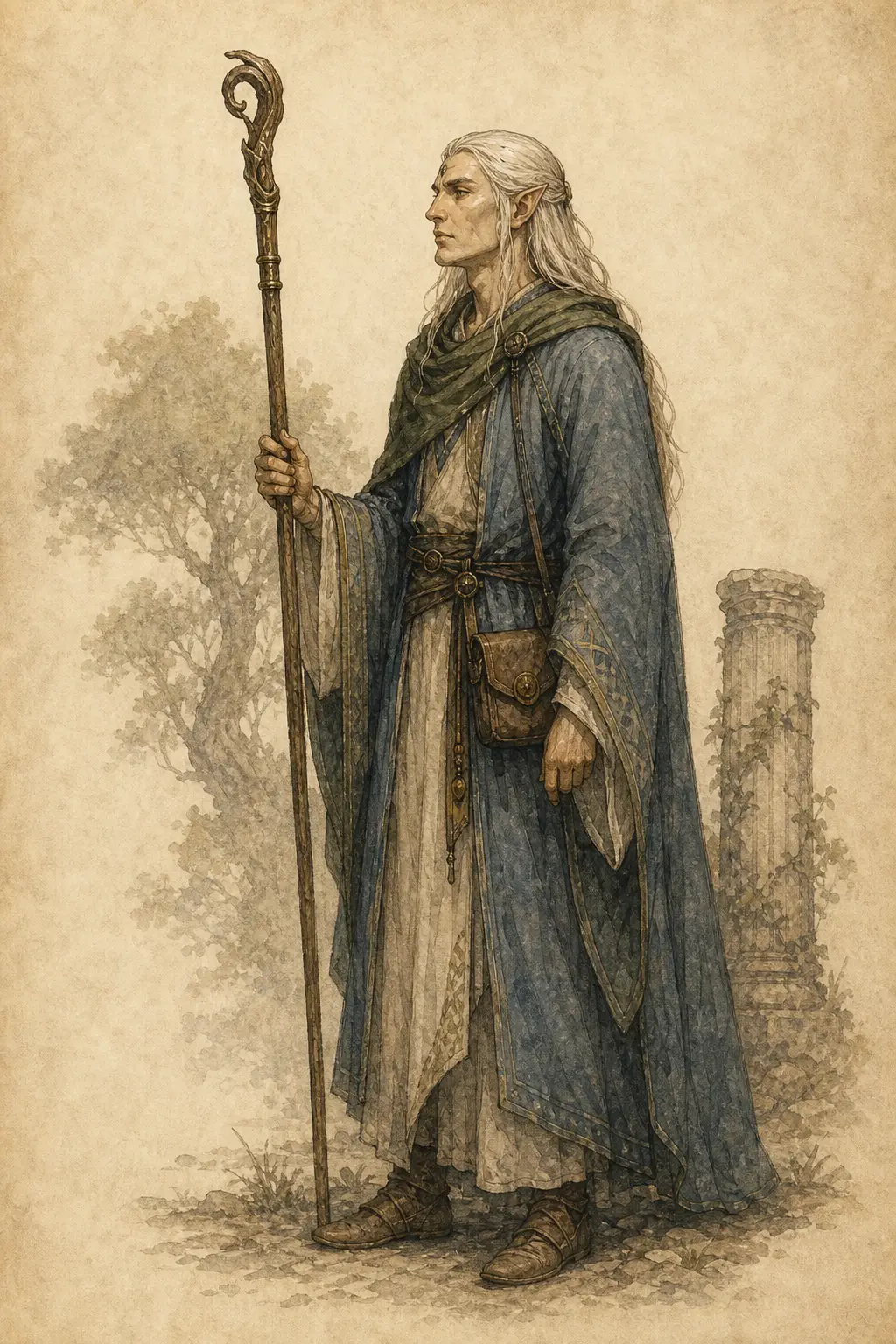
Salorras species: Elves — the oldest living people of the world, a legendary philosopher-race whose power grows with age. A standard 3.5e elf at youth, with a signature Salorras subsystem: an age-dependent Level Adjustment that unlocks ever-greater gifts as the elf passes century after century, culminating in the Philosopher King.
Origin: Khalendianil — the oldest living people of the world, unchanged since prehistory Stature: A little below the human average, slender and elegant — almond eyes, silken skin, metabolically lean Lifespan: Adult at one hundred and ten; the Philosopher’s Calling in the third or fourth century; Philosopher Kings approaching and beyond the millennium Bloodlines: anardil · isil · lumel · nendili · tavari · walda — six kingdoms, six sister philosophies Faith: Eone — the first philosopher among them, honored universally alongside each bloodline’s own traditions Languages: Native — Elven; honored — the ancient dragon-speech and the four elemental tongues; esoteric — the lost tongues of giants and other vanished peoples
The elves are perhaps the oldest people of Salorras whose foundations remain unchanged to this day. Centuries-old creatures who seem to have stepped out of human fairy tales, elves are a rare sight and take no part in the affairs of the other common peoples. Secluded in the elven lands of the elder continent of Khalendianil, this mythic people lets no one trespass uninvited upon their territory. A people deeply interwoven with the world’s prehistory, elves abide in their ancient traditions, upholding an idealized social model of philosophers who rule the citizenry with the support of their own mages; in their kingdoms reigns absolute harmony, where every elf has a role and serves a perfect society without a trace of base circumstance. Their population is tiny next to the other peoples, owing to their difficult reproduction, which happens only between compatible pairs and requires true affection — the “attunement” they themselves speak of. In youth, elves leave their homelands on a quest to find their identity, traveling the world to see with their own eyes all they were taught by their philosopher-masters.
Character
Elves stand out for the gentleness and wisdom that govern them. They are creatures of boundless patience with the ways of other peoples, and always act thinking of the impact of their deeds on the future and the balance of the world. Every elf learns from childhood to love themselves, tending to mind and body alike; they are troubled at the sight of pointless violence, yet rarely involve themselves directly in matters that do not concern them. They love the arts in all their forms and forever seek perfection in the things they love — and since time flows differently for them, adult elves are known as masters of their craft. They respect the elders of their kind, and the image of the philosopher-king under the aegis of the occultist mages is, for them, a life’s calling.
Appearance
Elves are little shorter than the human average, their limbs long and slender; their skin is almost always fair and soft as silk, their silhouette lean and elegant, for their metabolism never lets them carry extra weight. Their hair, black or blond, is straight, though the rest of the body is hairless; their almond eyes have heavenly pupils of light shades, though some have been seen pitch-black and lusterless. Elves come of age after their 110th year, and until then all prepare for the “Philosopher’s Journey,” a long rite that sends them to learn from the various lands of the world. As an elf matures, facets of personality and bodily ability unfold, so that they differ markedly from one another by age. They often dress lightly, in pale clothes of fine materials woven to last many years.
Neighbors and Rivals
Elves bond with others only with great difficulty, for their nature demands far more time than a human’s; yet if they form a friendship, it is something sacred they will honor forever, even if centuries pass without seeing their loved ones. Their people regard the other common peoples as a “little” sibling, though they would never let those civilizations come too close to their own. They prefer a neutral stance inclined toward peace, but if they must change a “variable” they believe is unbalancing the scales of the cosmos, they will not hesitate — however harsh it seems to others.
To most peoples of Salorras, elves seem something remote and “forgotten” from the depths of prehistory. dwarves call them xenophobic and withdrawn, for they truly know little of them; in most of the world, humans have never even seen an elf — for them, the “elves” are the elmaers. Still, on the rare occasions an elf appears in open view, reactions vary — admiration, awe, fear, or hatred being the most common.
Faith
Religion is a sensitive chord in elven culture. The beliefs in the spirit of Eone — one of the first elves — are an inseparable part of their culture, a doctrine that aims to identify with the world’s energies and become great philosophers of the world. To a greater or lesser degree, all elves hold in their hearts the doctrine of Eone, as well as the teachings of their people’s traditions.
Conscience
The morals of elves are unpredictable to the other peoples. Their stance is seemingly neutral, though in practice it may differ: there have been times elves intervened in the most appalling way in the world’s affairs under the pretext of “balance,” while in other texts they appear as saviors. However it be, these long-lived creatures have watched the world change more times than they can count — which makes them seem remote and arrogant to the common peoples, regardless that they themselves are not driven by racism.
Elven Domains
The ancient elven people appeared on the elder continent of Khalendianil, and there their kingdoms still hold seat to this day, deep in the mountain regions and the open valleys of the north. Their kingdoms divide into the six the elves named from within as peoples of their kind — those of the anardil, the isil, the lumel, the nendili, the tavari, and the walda. Each people has its own history, though the foundations of all are shared, and each people’s land is equally sacred and must remain untrodden by unworthy outsiders. Indeed, one enters the elven kingdoms only by the “Philosopher’s Invitation” — trespassers on the sacred elven soil rarely lived to tell their tale. Beyond the ancient kingdoms of Khalendianil, the elves hold no other domain in the material world; myths speak of an ideal land in the notional Continuums that ring the planet, but nothing has been confirmed.
Wanderers and Seekers
Adventure and seeking have occupied the elves since the dawn of the world. One of their foremost traditions is to send the young to travel the world and armor themselves with knowledge and experience. It is rare to meet an elf beyond their homelands, and if it happens, we almost always speak of one young in age.
Language
Elves have their own tongue, Elven — melodious, for the humans who have heard it say it sounds like “a flowing brook.” Beyond their own tongue and the idioms of each elven kingdom, elves often know the ancient speech of dragons, and it is not unlikely they know the tongues of the four elemental energies. As learned creatures who delight in languages, they may know any tongue — even some of lost civilizations, such as that of the giants.
Elf Starborns
There is no known elven starborn in history to date. A myth speaks of the first elven starborn yet to come into the world, who will bring deliverance to the balance of energies — while other versions tell of the world’s revelation.
Names
Every elf is baptized by the philosopher-kings, who decide the name given according to the positions of the outer dimensions and how they influence Salorras — whether waning, neighboring, or waxing, and whether this comes through the shadow or through the aether.
Male names: Aerendyl, Adorellan, Avithmisir, Biarmirin, Elinthyr, Elorfindal, Evindilir, Ioliisir, Liorimas, Iliriasin, Kalaerin, Phaendar, Myrdin, Naerakir, Raelfir, Synamrel, Thrimilin, Valamaerm. Female names: Anaryiliis, Abrylane, Briliria, Calanthra, Ealmyrna, Ellavria, Freyalia, Ghelnia, Ioliis, Kleavi, Liviria, Maluriavi, Nyavela, Olivandria, Phalminia, Quyern, Selviria, Trisvarma, Valenthra, Ylmariis. Family and House names: Amarigalyr, Aranthyle, Caulthor, Eleminor, Faylirinth, Ilvinorimyth, Kyelmar, Larimor, Myatharandir, Nellerimor, Otriamaranth, Quillisar, Sythrantyle, Valaminyr, Ylfarantis.
Elf Racial Traits
Elves stand apart from every other people of Salorras not so much for their physical presence — their silhouette is delicate and their endurance relatively fragile — as for their deep familiarity with the world and its dimensions. They are ancient creatures whose intellectual and mystical faculties are enriched with them as the years pass. Whatever an elf loses in physical drive is repaid in perception, wisdom, and communion with the powers that surround them.
- +2 Dexterity, –2 Constitution: Elves are graceful but somewhat fragile.
- Medium: As Medium creatures, elves have no special bonuses or penalties due to their size.
- Speed: Elf base land speed is 30 feet.
- Low-Light Vision: An elf can see twice as far as a human in starlight, moonlight, torchlight, and similar conditions of poor illumination, retaining the ability to distinguish color and detail.
- Twilight Senses: +2 racial bonus on Listen, Search, and Spot checks.
- Meditative Repose: Elves do not sleep. Instead they enter a deep trance of slowed senses that rests them as fully as sleep does other peoples. While in this state they remain dimly aware and may make Listen and Spot checks at a –10 penalty.
- Elven Heritage: An elf gains a +2 racial bonus on saving throws against mind-affecting effects and is immune to magic sleep effects.
- Automatic Languages: Elven and one Regional tongue (of the elf’s homeland). Bonus Languages: Auran, Aquan, Draconic, Ignan, Merylia, Terran.
- Favored Class: Wizard. A multiclass elf’s wizard class does not count when determining the experience-point penalty for multiclassing.
- Age-Dependent Level Adjustment: An elf’s level adjustment depends on their age, per The Long Years below. A player may make a young elf and invest fully in class levels, or unlock the deeper racial gifts of an older elf by accepting the higher level adjustment.
The Long Years (Level Adjustment by Age)
Elves come of age no sooner than their second century, and even then a young elf is considered only just begun upon their path. From that first step of maturity, a slow but unstoppable transformation begins: the body loses its youthful vigor — growing more fragile, weaker, slower — while the centuries grant in its place a steadily widening intellectual and spiritual acuity, a penetration into the world’s secrets, and an immediacy in communing with the powers around them.
| Age | Level Adjustment | Racial gifts gained |
|---|---|---|
| 110–170 years | +0 | Standard traits |
| 171–360 years | +1 | Elven Insight 1/day; extra ability point; Skill Focus feat |
| 361–640 years | +2 | –1 Str/Dex/Con, +1 Int/Wis/Cha; bonus feat; The Philosopher’s Calling |
| 641–880 years | +3 | –2 Str/Dex/Con, +2 Int/Wis/Cha; Elven Insight 2/day; Skill Focus feat |
| 881+ years | +4 | –3 Str/Dex/Con, +3 Int/Wis/Cha; bonus feat; Philosopher King |
(The ability shifts at each band are cumulative with the base traits, and represent the body’s decline traded for the mind’s ascent. A player chooses their elf’s age at creation; the gifts of every band up to that age are gained.)
Elven Insight (Ex): Once per day, an elf may roll 1d6 and add the result to any attack roll, saving throw, or skill check — declared after the d20 is rolled. An elf of level adjustment +3 or higher may use this twice per day.
Extra Ability Point: The elf gains 1 extra ability point.
Skill Focus Feat: The elf gains Skill Focus as a bonus feat (twice, for an elf who reaches level adjustment +3).
Bonus Feat: The elf gains one extra feat (two, for an elf who reaches level adjustment +4).
The Philosopher’s Calling (Ex): Upon reaching the age of a philosopher of their kind, the elf chooses one of the five philosophical paths below and may use its abilities freely; the choice is unique and irrevocable, reflecting the true calling of heart and mind. With it comes the right to enter the untrodden elven lands of Khalendianil, sacred places closed until then even to their own kin.
- Philosopher of the Arcane: The elf bends the laws that govern their spells, able to prepare any spell as though it were one level lower than normal, though its casting time rises by one step (for example, a fireball prepared in a 2nd-level slot, cast as a full-round action). This combines normally with any metamagic feat. At level adjustment +3: the elf may force a damaging spell to deal automatically 60% of its maximum damage, rounded down (an 8d6 fireball, max 48, deals 28).
- Philosopher of the Blade: The elf weaves a bond with a weapon used exclusively for over a year, gaining a +2 bonus on all attack and damage rolls with it; if they ever change weapons, another full year of exclusive use is needed to reforge the bond. At level adjustment +3: the bonded weapon’s critical modifier improves by one step (a longsword becomes 19–20/×3; a greataxe 20/×4).
- Philosopher of the Arts: The elf reaches such mastery that their meditation becomes brief but absolute, restoring hit points, spells, and any ability that requires rest in only four hours instead of eight — but the next such repose then requires a full sixteen. At level adjustment +3: once per day, as an immediate action, the elf may inspire an ally with their words, letting that ally reroll any d20 (attack, save, skill check, and so on).
- Philosopher of the Divines: The elf becomes a conduit of divine energy. Three times per day they add to an attack roll a sacred bonus equal to their highest mental ability modifier (Int, Wis, or Cha — chosen once and fixed). At level adjustment +3: using this ability also grants damage reduction equal to that bonus, overcome only by +5 or better magic, for 6 rounds.
- Philosopher of Transitions: The elf has studied the transitive realms of shadow, aether, and mirror so deeply they draw power from them, gaining a bonus on Stealth (Hide and Move Silently) checks equal to their Hit Dice. At level adjustment +3: once per day they may use dimension door as a spell-like ability (caster level equal to their Hit Dice), unusable where there is no contact with a transitive realm.
Philosopher King (Ex): Having brought mind and body into full harmony with the world’s existence, the Philosopher King may, on any Will saving throw, choose to take 10 rather than roll. In addition, their Wisdom modifier (minimum +1) is added automatically to their hit point total and to their Initiative.